
These days, I frequently catch myself reminiscing about the days in Europe. The carefree spiritedness, the freedom, and the feeling of the hot sun and salt water on my skin. It struck me at the core how much I missed this sense of playfulness, at a time in my life when I thought I would be solely focused on one thing: work.
And I gave myself that time off. After five long years of college, I gave myself the permission to not worry and to explore without thinking about what was next. Soon, I found myself craving more and more, extracting snippets of memories of the serene beauty I observed across a different continent and culture.
That craving never quite goes away despite how much I want to suppress it. Work to me has become, honest to god, quite joyless. The fact is, I’ve become quite miserable and part of the reason is that I never fully understood how to deal with the expectation gap.
At different parts of my life, I expected to ‘be somewhere’ and to be ‘doing something’. I had my allotted time to travel, thus I wasn’t ‘allowed’ to have any more fun until I accomplished certain career milestones.
My obsession with having a dream career, a linear line from A to B, has caused me only to have a lot of angst and not be very effective at living the life I truly want.
In full honesty, I want to wake up every day and look forward to it. I want to enjoy little moments throughout the day, celebrate life with my loved ones, and enjoy my work. And it’s difficult because in order to survive in this world of ours, we need to work— sometimes what feels like all the damn time.
But in moments like this, you can either choose to be constricted by your environment, or you can choose another option. You can choose to lock yourself in your home all day to work, and that’s perfectly fine if that’s what you genuinely enjoy. But if you’re doing it because you think that making yourself miserable temporarily, will lead to some desirable outcome in the future, I urge you to tread carefully on that road.
Try to Have Fun on the Way to the “End”
Most likely, if you suffer from the expectation gap—which is the time or distance between where you are now, and what you desire to have—you have some type of ambitious end goal. It could be a position at work, a certain lifestyle, a vacation, or buying your dream home or car.
I’m going to assume that 90% of people don’t have what they want.
And that’s purely based on the human tendency to always want the ‘next best’ thing. Even when we got what we originally wanted.
If you hit a certain milestone at work, all you’re thinking of is how do I get to the next, bigger one. Or, you get overwhelmed by the amount of work that comes with the newfound responsibility.
I’m so guilty of getting bogged down by what I don’t have, and instead of trying to enjoy the process and follow through on incremental goals.
The process is not always fun, I’ll give you that. The process of getting from somewhere you’re not happy with to the end is a long, treacherous ride. And at times, you just want to give up, especially when you’re presented with external or internal obstacles.
However, it is possible and likely beneficial if you put some effort into making the process more fun. For example, a simple example I can think of was in college when I was working at a coffee shop—despite hating the work, I made some absolutely stellar friends. They made work so fun that I couldn’t let myself quit despite how much management sucked. It allowed me to pay for things and save up, and luckily, it’s because of the hours I put in I was able to not worry during disastrous times like the pandemic.
One thing I’m learning to do when it comes to managing my expectations is ‘allowing myself’ to receive pleasure and joy. When you’ve conditioned yourself not to feel, or not to enjoy —and just to ‘push forward’ until you get to the final destination, you have to remind yourself to quite literally ‘stop and smell the roses’.
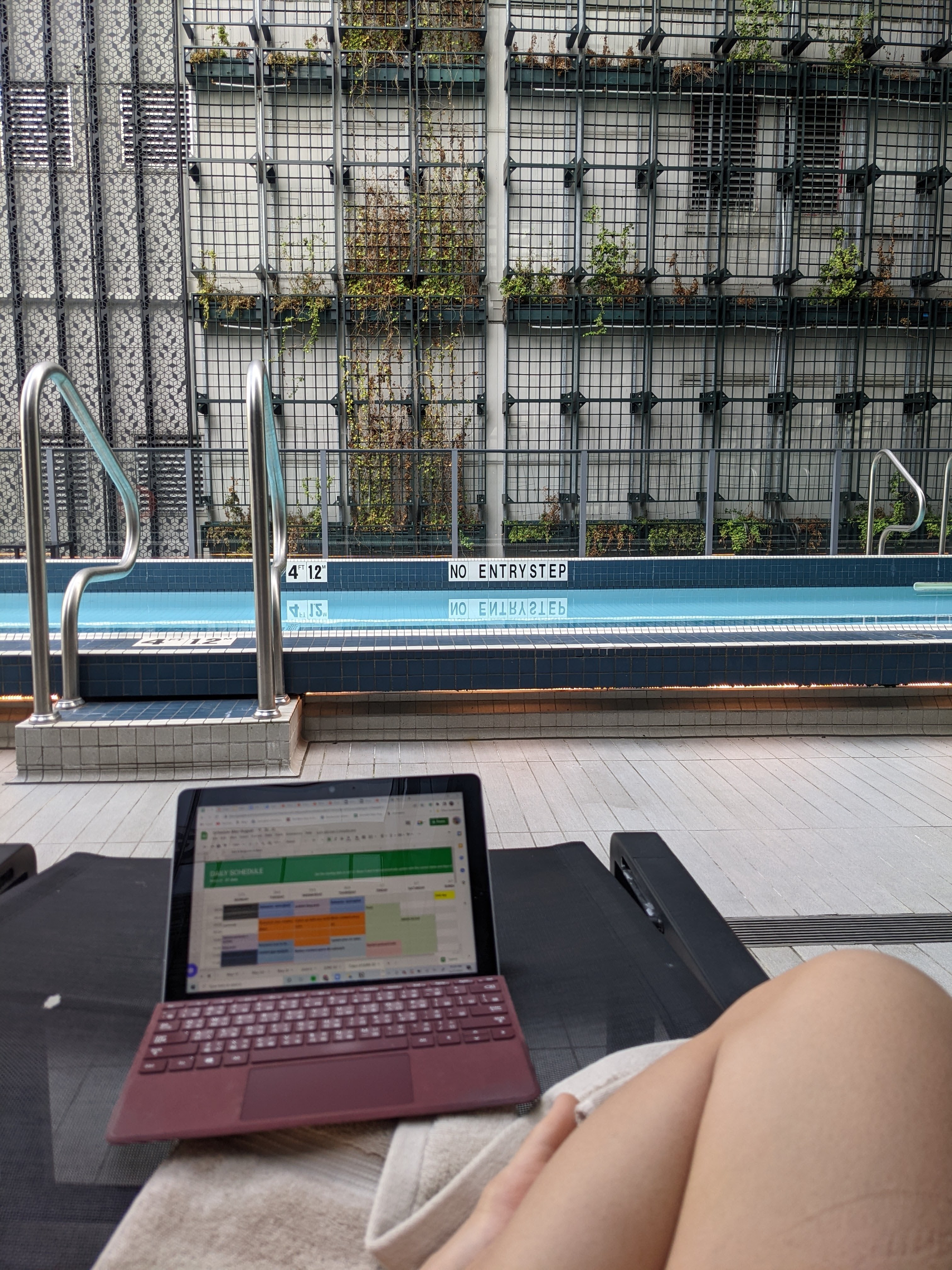
What this looks like for me recently is working by the pool and listening to house music in the background. I feel very fortunate to be able to go down the elevator and have access to a beautiful outdoor swimming pool and hear the birds chirping at all times of the day (this is because the wall adjacent to it, is a ‘living’ wall.) It brings me such a sense of calmness. And calmness is probably the most overrated tool in the productivity arsenal. How are you going to accomplish your best work if you’re constantly strained, stressed out, and scatter-minded?
Having a set routine but also allowing space for spontaneity and fun may just give you enough energy to preserve through the long haul of your goals, especially those tough ones.
Having (Time) Realistic Expectations

We’re in an instant-gratification world. At the touch of your fingertips, you can have ‘access’ to hundreds and thousands of glamorous, well-put-together highlights of someone else’s life. I’ve written about some of the most ambitious human beings, and trust me the numbers don’t dwindle by the day.
Because we only see, hear and read about success; we fail to recognize the rocky path of getting to that ‘end goal’. We think that because we don’t have a million dollars in the bank account, or we’re not jet-setting across the Mediterranean, already, our lives just plain ole suck. Or maybe that’s just me.
One of the foundational pillars of SMART goals is being time-realistic. Contrary to popular opinion, giving yourself severe deadlines may lead to a sense of failure, if you don’t manage to achieve everything you set out to do. Some might argue that if you aim big, then at least what you fall down on—is still further than if you haven’t set out a large goal. That is true, but the majority of the time we tend to focus on the negative, so if you fail to hit that large goal—you’re going to feel bad about yourself regardless of how far you’ve come.
It’s great to cast big nets and allow yourself the time to get there. One thing I’ve been thinking about lately is my relationship with my body and fitness. I don’t have a concrete “I have to look like this or lose this amount of weight in three months”, rather, I have an overall intention of how I want to feel and look.
Obviously, I want to challenge myself to become and look stronger and more defined, but I prioritize consistency above all else. I never feel overwhelmed, “because I don’t look like a fitness model”, and never feel derailed from going to the gym regularly.
You can apply this shift of expectations to other areas of your life as well: relationships, work, health; sometimes you really do just need to go with the flow but still have an end goal in mind.
Having High Expectations Should Not Contradict Self Compassion
My example with fitness is very contrarian to how I perceive myself in a work setting. In one case, I am very kind, patient, and tolerable to myself. This has allowed me to become resilient, realistic, and consistent in building the right habits to help me achieve my overall aim.
The second case with work, I’m constantly thinking about all the expectations I’m not managing to hit, and in turn, this has made me disoriented and many times felt so hopeless that I just wanted to resort to doing absolutely nothing.
To many, self-compassion might seem like a road to laziness. In truth, when practiced it could just be the difference between the present you and the more effective version of yourself.
So how can we practice self-compassion in a way that can be conducive to our goals?
One, allowing yourself to feel joy, pleasure, and love— even for small things, small moments throughout the day.
Two, not being overly self-critical when something goes wrong. If you’re constantly in a negative cycle of self-doubt—you’re more likely to procrastinate on the work or project the type of energy that people don’t want to be around or collaborate with.
Three, learn how to soothe and de-escalate your emotions in hard times.
Overall, I think of self-compassion as a practice of nurturing your soul. Being your own best friend so you can recover from adverse life events faster and get back to building your fullest potential.
Enjoying a Flexible Mindset
It’s often difficult for disciplined individuals to see flexibility as a good thing. However, being adaptable and flexible can come in extremely handy in a multitude of situations. Let’s imagine a totally bogus scenario. Imagine you’re a cashier and all you’ve been trained to do is one thing: stand in front of the till, ring in items, and collect cash. Now, imagine if there was a horrendous situation where a violent, mentally insane burglar comes in with a gun and demands that you give them a loaf of premium bread without paying for it. Now because you’ve only been trained to look at things one way, you reject the burglar’s simple request and get shot in the head.
What this story recounts is the necessity of having a flexible mindset. Finding creative solutions around one problem, that sometimes can’t be solved in the given moment with one tactic. And this is difficult for most because we think why would we put all our training and learning to waste if we could just spontaneously approach different situations. Obviously, a fair degree of training is necessary for most occupations, for example, as a surgeon, but even in these cases a degree of flexibility is arguably essential because of all the different types of situations that can arise.
When we allow ourselves to open up and see the various paths that are available to get to one place, we make the process a lot more fun. Sometimes, it might take a little longer, and we may even find detours, or we may even find a further destination we want to get to. All in all, life can be as simple or as hard as you make it out to be. In school, no teacher will begin with the last chapter of the textbook, because all that learning is cumulative. Such concept also applies to life sometimes.
Conclusion
This is more a note to myself and anyone out there who’s struggling with the same thing.
Have. more. fun. with. It.
Don’t let yourself be confined to what you think “is right’ or what everyone else is doing. Rules don’t apply similarly to everyone. Some people love working 9 to 5s, and others like starting their work at midnight. It doesn’t really detract from their quality of work, whether you wake up early or go to bed late.
Think about an actor who works 16-hour days filming a blockbuster and someone who works two jobs to make ends meet. You might attribute 16-hour days to someone who is super hardworking and successful, but those 16 hours can produce very different results. The actor is building a legacy through their passion and the hard worker might be building resilience, but ultimately, they are trading most of their time to survive.
If you suspect you might suffer from the expectation gap, one telltale sign is mapping out exactly what you’re doing with your time. Do you spend most of your time actually doing things that will contribute to your end goal, or do you spend most of your time worrying about the end goal itself?
I’ll leave you with that food for thought.

 Secret Prose
Leave a comment