

Having a lot of grand goals and ambitions can be a wonderful thing, yet it can also become the deadliest trap. As information becomes more accessible, the things that tug at our attention are increasing. I recently skimmed a headline on my news feed. The photo: one person in their bedroom with multiple monitors. The headline itself went something along the lines of this: Why Millennials are Secretly Balancing Multiple Jobs. It’s not so much that one job isn’t enough to cover the bases (which can be true), but more so that people are surrounded by the messaging of side hustles and having to excel in multiple skill sets rather than one. If you’re an engineer, you can’t just be good with math and engineering, you also have to be a stellar customer rep! Meanwhile, there’s a digital trail of ‘self-made’ CEOs working around the clock and doing the job of 10 people. The more stories we hear about these work habits and lifestyles, the more normalized we think it is to always diversify our time and energy.
However as the old saying goes, “Jack of all Trades, Master of None”– if you truly want to master your trade/craft/passion, you can’t be throwing all your eggs in ten baskets. Sure, one of them might fare better than others, but only you know where your true strengths lie.
In a recent Inc. article, Warren Buffet, the legendary investor and the second richest person in the world advises people against diversifying their energy and to only focus their energy on the top five priorities. Sure, you can get better at something you’re bad at or not interested in, but with 10x the energy it would cost you to improve something you already have an advantage in. The #1 thing here is passion. It’s different when there is something you’re passionate about and you want to learn and improve that. What I’m referring to is when people force themselves in learning something, because they think it will be beneficial. One simple example is this. There is this a common rhetoric that every successful person reads physical books. I find this to be a blanket statement that disregards ambitious or successful people that don’t like to read books. There’s many ways one can amass knowledge other than picking up a physical book, especially with the internet. Do you really think Elon Musk has time between SpaceX and Tesla, and his Twitter battle to sit down for a leisurely read? And this is coming from avid book reader.
The “Right Thing” Changes all the time
I studied political science at university. Hands-down I loved it because it created an endless loop of curiosity about the world, power imbalances, and conflicts. However, I thought for a period in my life that the “right way” was to pursue something economic and finance-related. I’ve even considered taking the CFA between school and work (one of the most difficult investing credentials). Of course, I had little interest in finance and I was horrendous at math. Now we can all guess how that story went. Today, I literally allocate all my investment needs to someone else who is actually dedicated and passionate about the subject.
The thing is these “genres” which we think will be the most lucrative, change all the time and depend completely on context. For most of my life, my parents wanted me to go into the sciences, in hopes of “a stable job.” Nowadays, it’s all about computer science if you want a stable job. As you can see, as the world evolves, so does the attractiveness of certain jobs. You shouldn’t try to mold yourself into what you think is “the next best thing”, but rather improve upon what you already excel at and try to cater to a niche that needs your skills. The more attractive a career is, the more competition there is too.
That was a long-winded intro for what I’m about to explain.
And what I’m about to explain is something I have yet to master.
That is streamlining your attention for optimal results.
Prioritize, prioritize, prioritize

If you’re anything like me, you always crave the next cliff or the next “high.” I’m not talking about it in a physical sense, but rather a metaphorical one. Maybe it’s the Sagittarius speaking, but we become bored quickly with complacency—we’re always seeking ways to utilize our creativity, learn new skills and embark on new adventures—both in life and in work. Without this constant wave of excitement to entertain us, we fall into a state of depression.
Pros: I’m incredibly dynamic, adaptable, and eager to try new things.
Cons: I’m incredibly distracted.
These days I can barely sit still for an hour in front of my laptop writing.
For an entire month, I couldn’t even do what I was originally hired to do: write.
I struggled immensely to stay satisfied with writing, so I pursued other administrative tasks, hiring, consolidating data, and culture forming blah blah blah.
Not to say, any of those things were not productive, but they took me away from what I was meant to do.
I put myself in a situation where I straddled all my energy, diffusing it in different directions.
I burned out.
Point here.
We can be so caught up in the go-go mentality that we often fail to reflect on what our true priorities are. Our priorities become muddled and soon we fail to meet our own expectations for growth. Instead of growing by a whole foot, we find ourselves growing only inches in what we truly care for.
Bottom line: If you don’t know what your priorities are, you will always find yourself astray.
Let your priorities be a compass— and when you start to feel a little off the mark, come back to reevaluate your priorities.
Know Exactly What You’re Doing, When, and Where You’re Doing it
I read something recently extremely powerful in the book that requires no intro, Atomic Habits. We don’t achieve successful habits through our motivation, but rather through the systems we put in place to achieve them.
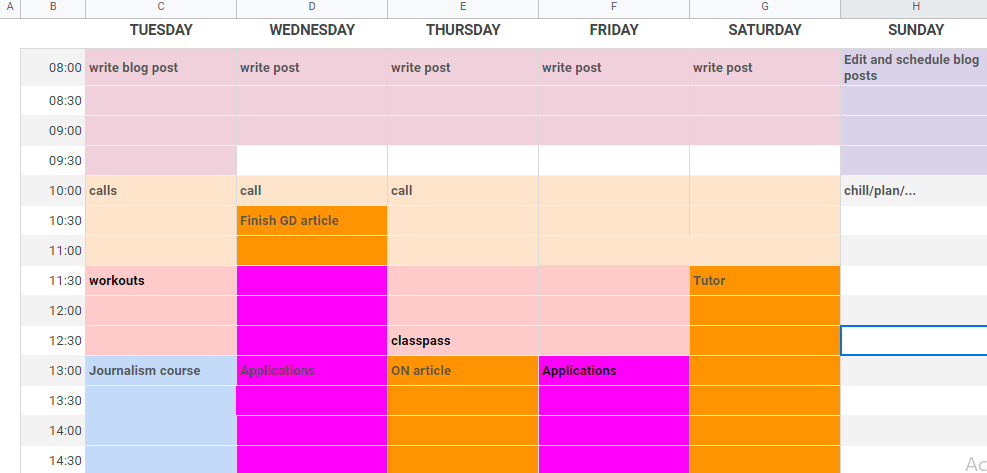
Once you map out your priorities or the things you really desire to achieve “the end goal”, make sure what you’re doing every day is in line with those objectives. It sounds like a pain in the ass to actually write out what you’re doing every day, but trust me, this simple step will free up a lot of your mental energy during the week. On days when we don’t feel necessarily motivated, our decision-making power goes down the drain. Seriously. Write it out, so you don’t have to rely on memory or motivation to start the action.
I try to map out at least one or two weeks in advance. For example, mornings this week are dedicated to writing one post for the blog. From 10 onwards is calls. After calls, naturally, I know I will feel a little disoriented so it might be a good time to head to the gym. After gym and lunch, I’ll start writing again or dive into this journalism course I’m taking. Your routine will be your key to unlocking more freedom in your life. You can time-block hours specifically for “off-screen” time. For example, I will literally time block 2 – 4 hours for “date night” or “hang out with (friend). Blocking out time for self-care and replenishing activities is essential so you can perform at your best in your productive hours.
When we’re consumed with work, we can start to neglect the other equally important areas of our lives: physical health, mental health, relationships..etc. It happens to the best of us, but be wary of it. When we make time for replenishing activities, it will bring more clarity and motivation to go harder in our work.
Learn how to give up “control”

It’s tempting to adhere to the mindset that we really “can do it all.” However, if you really want to streamline your attention on what matters the most, you need to learn how to give up some control in the other areas that are weighing you down. This might require some capital investment, but once you offload some of the responsibilities you’re being held hostage by, you’ll have a lot more space to pursue what truly brings you fulfillment and purpose.
Even things like scheduling, checking up on messages, and making sure you’re not forgetting an obligation is crucial for your professional reputation. My goal is to offload these day-to-day tasks to someone who’s designated at doing these types of tasks. Other AI tools like Alexa or Siri, can help you with some of that, but only to a certain extent.
When you have to constantly come out of your flow state, to address things like pings and messages, this can erode the overall length and quality of flow time.
I’ve noticed as I’ve gotten more responsibilities with work, the less focused I am on my primary tasks like writing. I used to be able to go hours in a concentrated state, and now I find that extremely difficult.
Own your distractions
The best way to evaluate your behavior is to physically draw out what your priorities are, and organize your daily habits either inside the circle or outside. Anything outside of your circle of priorities, is hence, a distraction.
For me distractions might be social media, checking group chats that don’t involve me, and scanning the news with no intent.
One way to mitigate distractions is to either make them unnoticeable or replace them.
If I don’t want to check my phone, I’ll hide it somewhere while I work. If I don’t want to be tempted to check messages in the group chat, I’ll turn notifications to silent. I’ll limit news scanning to 3 articles a day and before I open up an article I have to ask myself how it corresponds to what I’m working on or writing about.
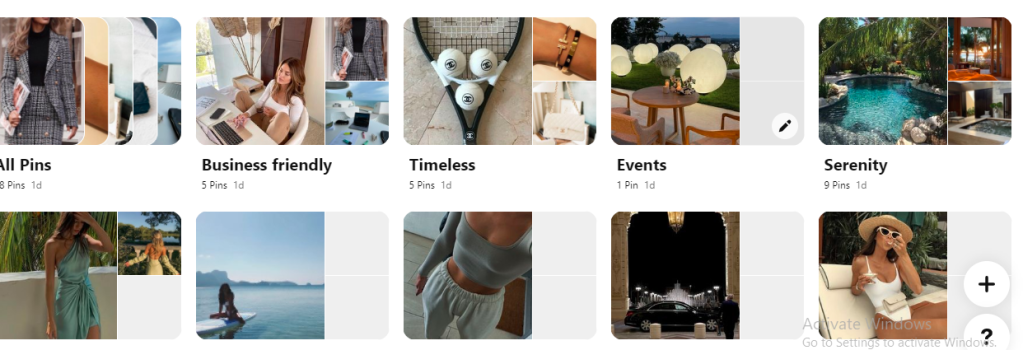
Calling out your distractions and naming a specific action you’ll use to address them improves the likelihood of you improving it. For example, scrolling through my social media feed to curb my boredom with a task is something extremely hard for me to get rid of. Therefore, what I can do instead is replace my ferocious IG habit, with going on Pinterest, starting a board like “personal content” or “blog content” and start to find and pin photos that bring me inspiration for my work or personal life.
Focus on what matters the most: Set personal and professional boundaries

If you enjoy going above and beyond, whether it’s in your work or your personal life—embrace that trait, but also be cautious about the shortcomings it can bring. Saying “yes” to everything is not necessarily going to win you the best results. Although at the moment you may feel like you’re contributing more by doing “more” things, the truth is, the opportunity cost of that is you taking away precious energy from the things that matter the most to you.
For example, you’ve taken on a few more tasks at work that are out of your responsibilities. You think you’re doing a good service to your boss, but you end up working later hours and spending less time with your loved ones. Now, spending time with your partner at the end of the workday may be a source of replenishment for you. Going one day, two days even a week without it might not feel like it’s impacting you negatively. But the compound effect of that leads to feeling drained and less creative to give that energy back into your work. These seemingly innocent occurrences happen more often than not. And the results are devastating.
Make every decision wisely. Before you jump to “yes”, think about the opportunity costs and whether these obligations drive you towards your priorities or away from them. Simply doing this exercise will help you cut down on irrelevant duties by likely 50%.
I know this was kind of a longer post— but I feel like recent happenings in my life have caused me to shift towards rethinking what my priorities are and how my actions might be misaligned. Hopefully, it brings greater clarity and has added value to you in some way.
Let’s get out of the monkey mind rut, and begin harnessing our powers into what matters truly to us and the world around us.
With Love & Compassion,
Naomi

 Secret Prose
Leave a comment